


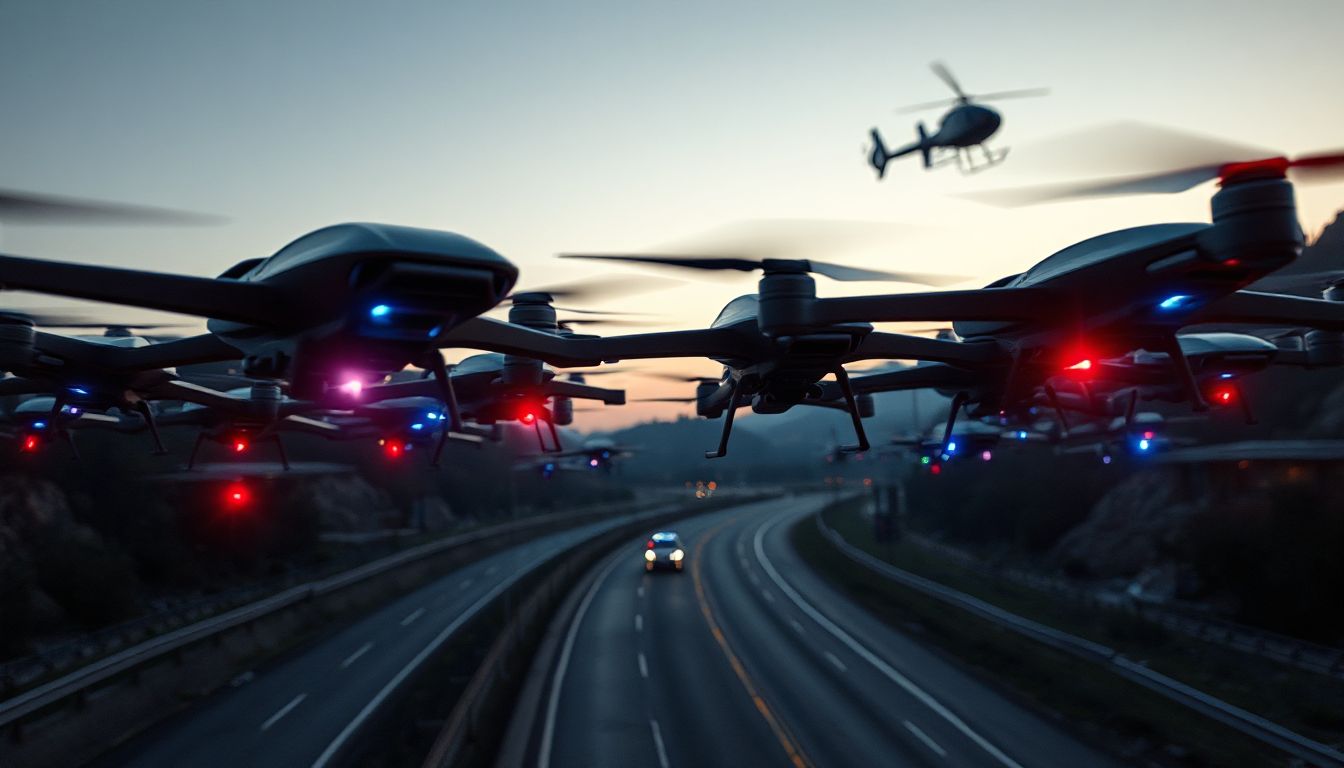
Will AI Swarming Drones Replace Police Helicopters for Pursuits?
The sound of a police helicopter has long been a familiar sound during pursuits, signalling an aerial advantage for the police. For many years, these machines have been indispensable tools, offering a bird’s-eye view, tactical support, and a deterrent to fleeing suspects along with ground units. However, the rapid advancement of artificial intelligence and drone technology is sparking a new conversation: could swarming drones, directed by AI, soon take the place of these traditional manned aircraft in the demanding role of pursuit observation and interdiction? This shift, if it occurs, would represent a significant evolution in policing, promising enhanced efficiency and safety, but also raising complex questions about deployment, ethics, and the future of aerial law enforcement.
The potential benefits are compelling. AI-powered drone swarms could offer unparalleled surveillance capabilities, covering wider areas simultaneously with greater persistence than a single helicopter. Their smaller size and agility might allow for closer observation in urban environments, while advanced AI could predict suspect behaviour and optimise pursuit strategies. But as we stand on the precipice of this technological transformation, it’s crucial to examine the practicalities, challenges, and the very real possibility of AI swarming drones becoming the future of aerial police pursuit.
(Police helicopters could be replaced by military-grade drones in parts of England and Wales under plans being pushed for by police and crime commissioners.
Currently, all forces pay to fund the National Police Air Service at a cost of more than £40 million per year.
Chairwoman of the Association of Police and Crime Commissioners Donna Jones said on Wednesday that around a third of forces want to use drones instead).

The Current Landscape of Police Aerial Pursuits
The Indispensable Role of Helicopters
Police helicopters are a vital part of many law enforcement agencies. They first became a standard tool in police work during the mid-20th century. Forces quickly saw the value of seeing things from above during pursuits and other major incidents. These aircraft provide a unique eye in the sky.
Helicopters play several key roles during police pursuits. They offer constant aerial observation and track suspects from a safe distance. Pilots give real-time information to officers on the ground. This helps ground units coordinate their movements, often boxing in a suspect. Helicopters also act as a strong deterrent, making suspects less likely to keep fleeing.
Many police forces rely heavily on helicopter support for successful pursuit resolutions. Their presence often increases the chances of a quick and safe end to a chase. However, these operations come with high costs. Maintenance, fuel, and pilot salaries add up quickly. Helicopters also need specific weather conditions to fly safely, and pilot availability can sometimes be an issue. These factors highlight some clear limits to current helicopter operations.
The Evolution of Drone Technology in Law Enforcement
Drones have steadily gained ground as a tool for police work. Early adoption saw drones used for simpler jobs, like documenting crime scenes or mapping accident sites. They provided a quick aerial view without the expense of a helicopter. These initial uses paved the way for more complex applications.
Technological advancements have truly transformed drones. Battery life has increased, and they can carry more weight. Sensors now include thermal cameras and high-resolution imaging, giving police powerful new eyes. Communication systems are also more reliable, allowing for better control and data sharing. These improvements make drones much more suitable for challenging police operations.
Today, police forces use drones in many ways. They might search for missing persons in tough terrain. Some departments use them for crowd control during large events. Drones can also inspect dangerous areas before officers enter. While not yet common for high-speed pursuits, their everyday use in other areas shows their growing potential. New regulations are always being worked out as drone use becomes more widespread, creating both opportunities and hurdles.
AI Swarming Drones: A New Paradigm for Pursuits

Defining AI-Powered Drone Swarms
Imagine many drones working together as one unit. This is the core concept of a drone swarm. These systems feature multiple drones that communicate, share data, and coordinate their actions. They do all of this without needing constant human input for every single move.
Artificial intelligence makes swarm coordination possible. AI algorithms allow the drones to make decisions on their own. They can recognise objects, track targets, and even predict movements. This collective intelligence means the swarm is much more than just a group of individual drones. It acts as a single, smart entity.
For police pursuits, these AI swarms offer powerful capabilities. They can find the best path dynamically, dodging obstacles in real-time. Autonomous target tracking ensures no suspect is lost, even in tricky areas. The swarm can combine data from all its drones, creating a complete picture of the pursuit. AI can also analyse suspect behaviour, perhaps guessing where they might try to go next.
Advantages Over Traditional Helicopters
AI swarming drones present many advantages over police helicopters. First, there’s a big difference in cost. Drones are much cheaper to buy and run than helicopters. Their maintenance is also less expensive, saving public money. This makes them a more budget-friendly option for aerial surveillance.
Another major benefit is the reduced risk to personnel. Pilots don’t have to fly into dangerous pursuit situations. This eliminates the chance of injury or worse for officers in the air. Drone swarms protect human lives during high-risk operations.
Drones also offer much better surveillance coverage. A swarm can spread out, watching a larger area than a single helicopter. This means they can keep eyes on multiple targets at once, or maintain unbroken watch for much longer. Their small size makes them agile, too. They can navigate tight city streets or fly low, where helicopters can’t go. This makes them perfect for urban chases.
Furthermore, drones could operate for longer periods. They might use distributed power or have mobile quick-charging options. This offers greater persistence during extended pursuits. AI also excels at processing vast amounts of data quickly, much faster than human operators can. This means quicker insights for ground teams.
Challenges and Considerations for AI Drone Swarms in Pursuits

Technical and Operational Hurdles
Before AI drone swarms can be widely used, some big technical issues need solving. Battery life is a major concern. Current drone batteries often don’t last long enough for long pursuits. We need much better power sources for extended operations.
Communication reliability is another hurdle. Swarms need robust, secure, and high-bandwidth connections. This ensures drones can talk to each other and to ground control without fail. Any drop in signal could break the swarm’s coordination.
Weather also plays a role, though perhaps less than for helicopters. Strong winds or heavy rain could still affect drone performance. Extreme conditions might make swarm operations impossible. Payload limits are also a factor. What types of sensors or tools can a small drone effectively carry? This impacts their overall usefulness.
Finally, cybersecurity is vital. AI systems and their communication links are targets for hacking. Ensuring they are safe from interference or spoofing is absolutely crucial. A compromised drone swarm could become a serious problem.
Ethical and Legal Frameworks
The use of AI drone swarms brings up many complex ethical and legal questions. Privacy is a big concern. Swarms could collect vast amounts of data and video from large areas. How will this affect public privacy, and who will control this information? We need clear rules.
What about the use of force? If drones were ever equipped with less-lethal tools, this raises serious ethical points. Who makes the decision to use force, an AI or a human? The idea of autonomous systems taking such actions needs deep thought.
Accountability is another key issue. If an AI system makes a mistake during a pursuit, who is to blame? Is it the police force, the drone manufacturer, or the AI programmer? Clear lines of responsibility are needed. Public trust also matters greatly. How will people react to constant surveillance by autonomous drone swarms? Gaining public acceptance is important.
New laws and policies are definitely required to manage these technologies. The legal framework hasn’t caught up with these advancements yet. Experts often highlight the need for careful debate on ethical AI use in policing. We must learn from those conversations.
Integration with Existing Law Enforcement Infrastructure
Bringing AI drone swarms into police work needs careful planning. How would these operations be managed by existing command centres? We need new systems for dispatch and tactical control. This ensures seamless integration with current police infrastructure.
Officers will also need new training. What skills will police personnel need to operate or monitor these advanced systems? Comprehensive training programmes are essential. This will prepare them for this new way of working.
Seamless communication between drones and ground units is also vital. Officers on the ground need real-time data and clear instructions from the swarm. Interoperability is key for effective operations. Data management is another big task. Swarms will generate huge amounts of video and information. Protocols are needed for handling, storing, and accessing this data properly.
Real-World Scenarios and Future Potential

Hypothetical Pursuit Scenarios
Imagine an urban chase in a busy city. An AI drone swarm could track a vehicle through tight streets. It might predict the suspect’s escape routes, guiding ground units to cut them off. The swarm could even spot the driver if they try to switch cars or run on foot. This gives officers a massive edge in complex urban areas.
In a rural pursuit, drones could provide persistent aerial coverage over vast areas. If a suspect drives off-road into a forest, the swarm could keep tracking. Thermal imaging could spot the suspect hidden in trees, even at night. The drones maintain watch far beyond what a single helicopter could manage.
What if a suspect tries to evade the drones? AI could learn evasion tactics. It might adapt its tracking patterns or deploy specific drones to counter common moves. This makes it much harder for suspects to simply lose the pursuing swarm. Precise identification is also a huge benefit. Drones could quickly confirm a vehicle’s number plate and identify occupants with high accuracy using facial recognition.
Pilot Programs and Early Adoptions
Some police forces are already looking at advanced drone technology. While full AI swarms for pursuits are not yet common, pilot programmes are underway. These trials often focus on refining drone capabilities for specific tasks. Forces might test improved tracking systems or better sensor integration.
Research and development in AI for police force drones is ongoing. Universities and private companies are working on smarter algorithms. They aim to make drones more autonomous and better at decision-making. These efforts pave the way for future pursuit applications.
We’re seeing limited deployments of drones in situations that mimic pursuit observation. For example, drones might monitor a fixed perimeter around a crime scene. They could track a known suspect moving slowly. These small steps build the experience needed for high-speed scenarios.
The Path Forward: Research, Development, and Deployment
Bringing AI swarming drones from an idea to widespread reality needs many steps. We need continued technological advancement. Better AI, stronger drone hardware, and more advanced sensors are all crucial. Innovations in battery power and communication range are also key.
Policy and regulatory development must also keep pace. Governments need to create clear guidelines and standards for this new technology. This ensures safe, ethical, and legal deployment. Public engagement and education are just as important. Open dialogue with communities builds trust and understanding.
For police forces thinking about this shift, now is the time to prepare. Start by reviewing your current aerial pursuit policies. Consider pilot testing smaller drone units for specific tasks. Invest in training for officers on drone operations. These steps will make the transition smoother when AI swarms become more viable.
Conclusion: A Glimpse into the Future of Aerial Law Enforcement

AI drone swarms offer compelling advantages for police pursuits. They promise lower costs, reduced risk to human pilots, and far greater surveillance coverage than traditional helicopters. Their agility in urban areas and ability to process vast amounts of data could truly transform how chases are managed.
However, significant challenges remain. We must overcome technical hurdles like battery life and communication reliability. More importantly, we need to tackle complex ethical issues around privacy and the use of force. Legal frameworks must also evolve rapidly.
It’s likely that AI drone swarms won’t simply replace helicopters overnight. Instead, they will probably start as complementary tools, working alongside manned aircraft. They could take on specific roles, freeing up helicopters for other critical tasks. This evolving role of technology will surely reshape law enforcement and public safety. The future of aerial police pursuit looks set for a major, AI-driven change, demanding careful thought as we move ahead.


Recent Comments